Missing Links: Noah Davis at the Hammer Museum
Art that pulls focus
When we go to exhibitions together, my wife and I pace ourselves differently. I usually wander ahead, looking at the work at a faster clip, and double back once I reach the end of a room. We meet up again and walk together until we reach the next room, and the cycle repeats.
Sometimes it makes me self-conscious. I worry that I’m not spending enough time in front of the work, digging into the surface of the paintings, the mass and armature of the sculptures, or the light of the photography and videos. I wonder if it’s my latent ADHD coming out or just a side effect of an attention span ruined by digital brain rot.
But then a show like Noah Davis at the Hammer Museum comes around and everything slows down. The footsteps become more measured, the self-consciousness of looking at art surrounded by crowds of people subsides, and the work creates a channel of energy between object and observer that makes everything else disappear. It’s a reminder that a museum show can still stun, amaze and mesmerize, that painting never died, and that there will always be artists who create work that transcends its specificity.
The Right Moment
Noah Davis is delicate. It arrives at a time of deep fatigue within the art world, a downstroke in passion, excitement and optimism for the future. Critics are writing articles about the death of the industry. There’s a general, creeping malaise brought on by a misalignment of interests between insiders and the general public. We have a president who is infringing on the curatorial independence of our nation’s institutions, and the presumption that preachy, overtly political work speaks to a receptive, like-minded audience is beginning to fall apart.
What Noah Davis gets right, and what makes his work so different, is that it recognizes that centering conversations, subjects, and narratives is best delivered as a function of form rather than content alone. Art is stronger when it shows rather than tells, when it displays rather than dictates, when it presents rather than points. These are works made from the heart rather than the head.
There is an embarrassment of riches here — exceptional painting after exceptional painting paired with curatorial framing that complements the work with understated wall texts. What stuck with me the most after I left was a small series, six in total, titled The Missing Link. They are a perfect demonstration of what art can do when it begins at the beginning — when composition preempts communication and when the medium is the message.
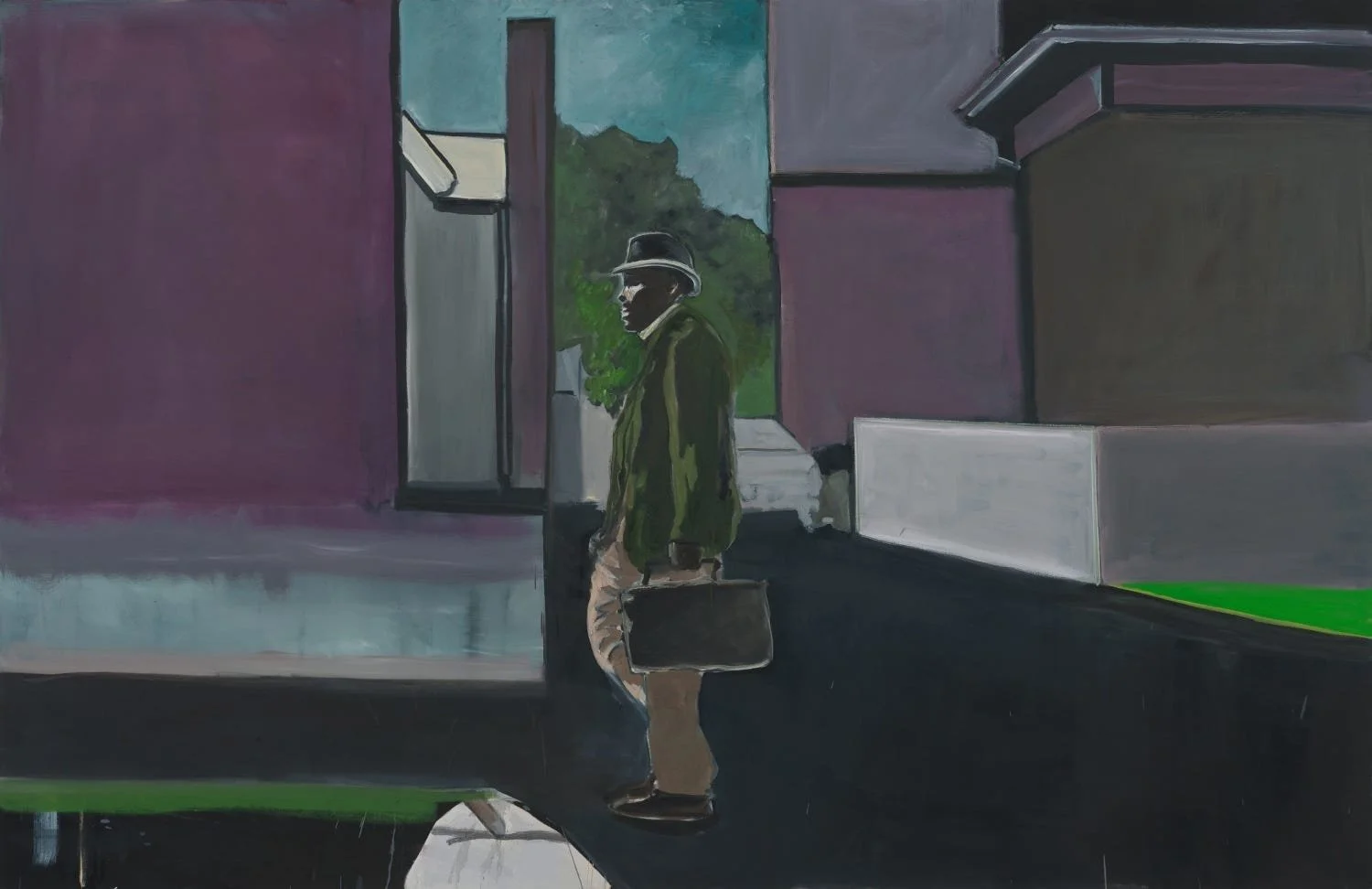
Noah Davis, The Missing Link 3, 2013, oil on canvas, 78.125 x 120 inches / 198.4 x 304.8 cm © Noah Davis
The Missing Links
In The Missing Link 3, a man wearing khaki pants, a green jacket and a fedora walks through a nondescript neighborhood carrying a briefcase. One knee slightly bent anticipates his next step forward. Two large, purple buildings tower over the gentleman, while a patch of unnaturally bright, green grass breaks the uniformity of the soft, powdery palette. A grey car parked beneath a large tree sits below a gentle sliver of blue sky.
The buildings, the vehicle and the fragments of nature surround the businessman who strolls through the scene nonchalantly with nothing to indicate where he is coming from or where he is going. The simplicity and overtness of the framing lets us know that whoever this man is, whatever his personal affairs, the painting is “about” him. It lays gentle claim to the figure’s subjecthood with the stroke of a brush by simply putting him in the center. Nothing more, nothing less.
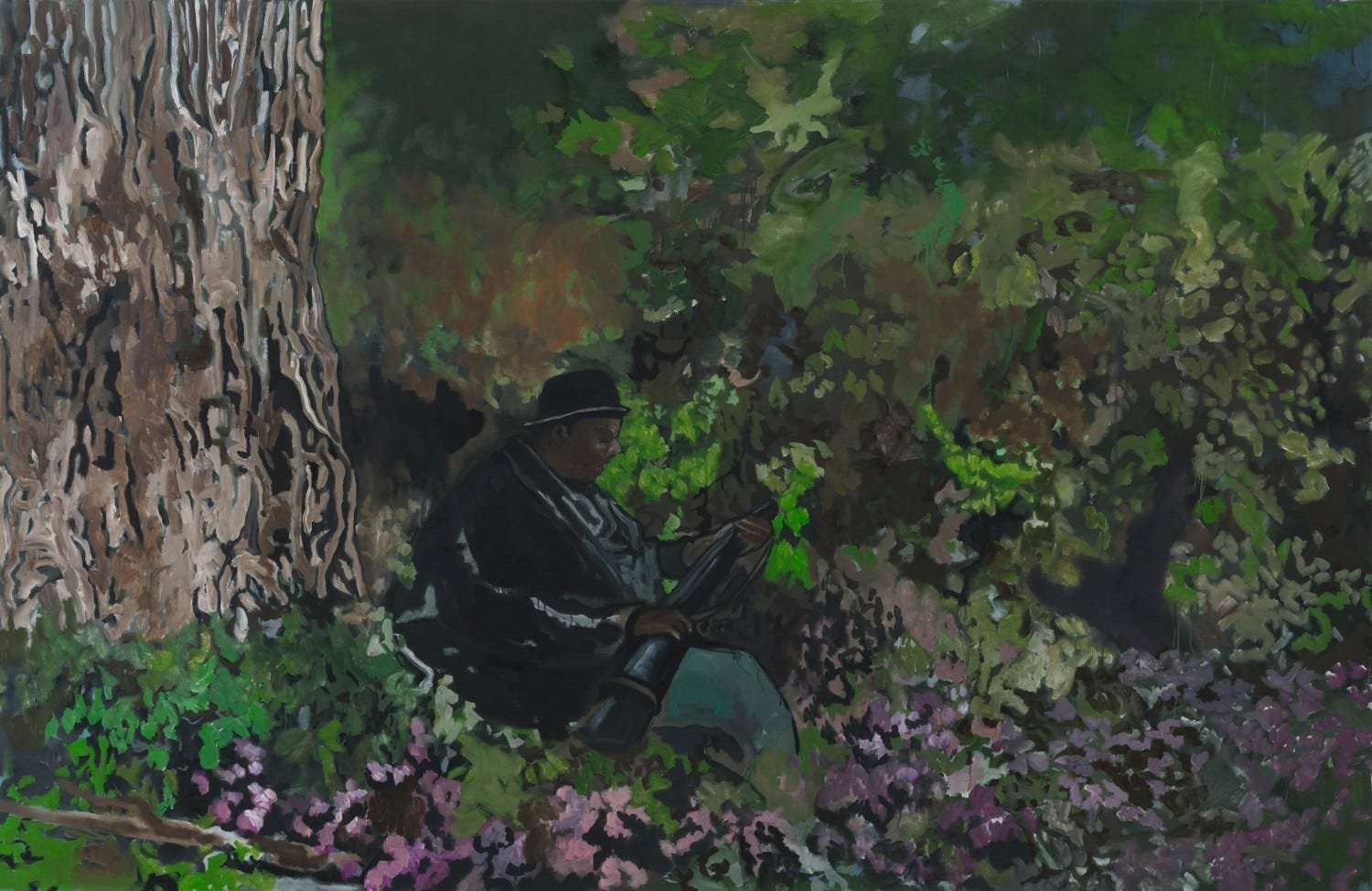
Noah Davis, The Missing Link 6, 2013, oil on canvas, 78.125 x 120 inches / 198.4 x 304.8 cm © Noah Davis
In The Missing Link 6, a man sits at the base of a tree holding what looks like a rifle in a leather case. In the foreground and background, speckled flora in pinks, purples and greens blend together to create a tapestry of smudged colors rendered like the bokeh of a wide-aperture photograph. The narrow depth of field is focused on the body of the gentleman and the item in his hands.
With his mouth slightly agape, unexpressive yet attentive, the figure occupies the center of the painting. Davis’s techniques brings him into focus with precision in the midst of the scene. The blurry tree trunk, flowers and bushes might have more vibrant colors than the figure, but their lack of focus draws the eye to the man. His centrality is subtle, yet obvious, a celebration of simple beingness.
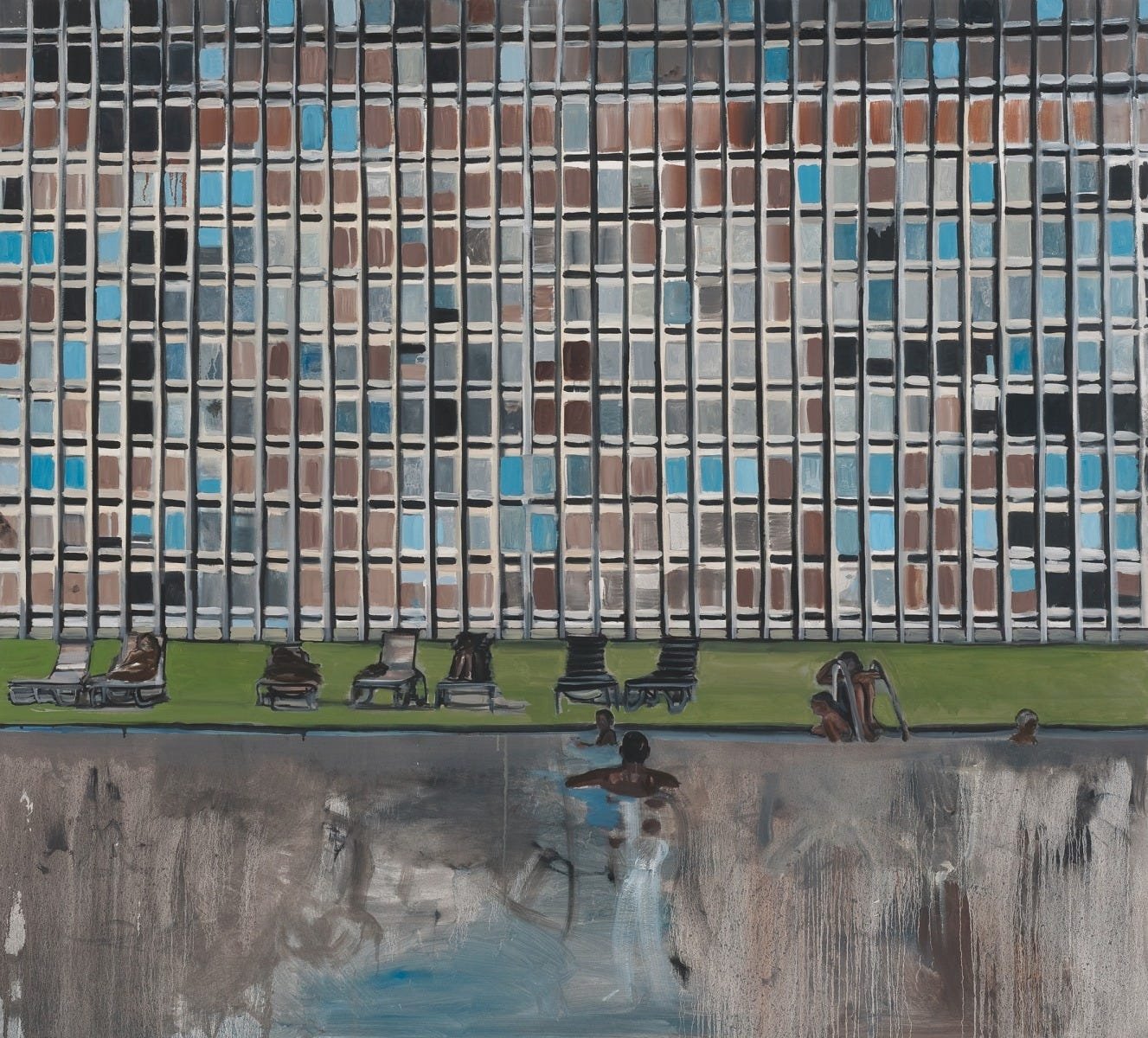
Noah Davis, The Missing Link 4, 2013, oil on canvas, 78 x 86.125 inches / 198.1 x 218.8 cm © Noah Davis
The Missing Link 4 is a pool scene. Five figures float in the water abutting a green lawn at the base of a flat building exterior composed of over 300 windows individually painted in a mixture of blues, greys, blacks, browns and whites. Seven reclining pool chairs arranged in a line give the impression of distance, suggesting a large body of water disproportionate to the depth of the lawn.
The painting prioritizes the bathers as a side effect of its composition according to the rule of thirds, bringing the viewer’s eyes prominently to their bodies, while the building becomes background, extending into a hypothetical infinity beyond the frame. The painting doesn’t indicate who or where they are, but their peace suspends their beingness in mid-air, ever present, here and now.
Noah Davis, The Missing Link 2, 2013, oil on canvas, 60.125 x 74 inches / 152.7 x 188.0 cm © Noah Davis
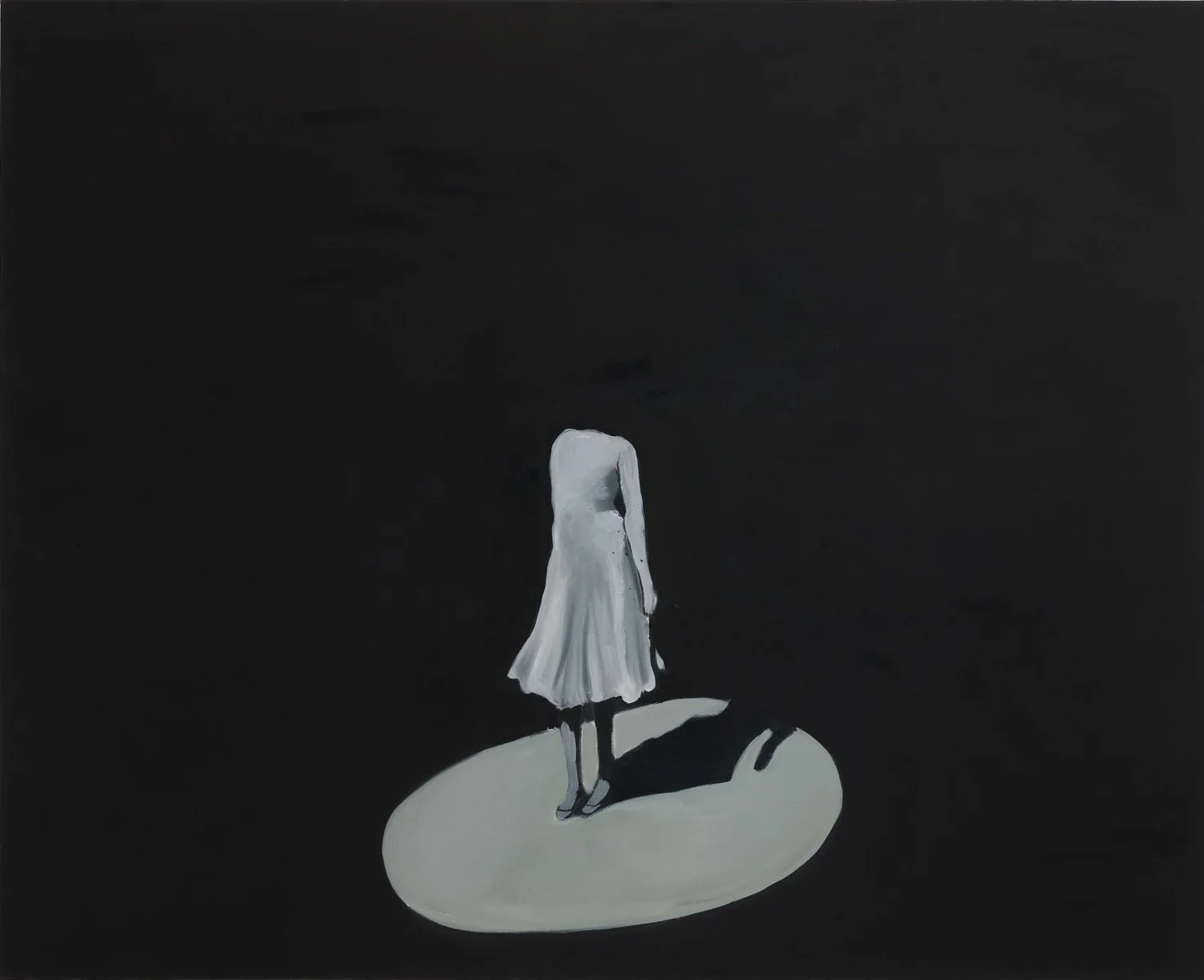
The Missing Link 2 features a jet black background punctuated by a figure wearing a white, flowy knee-length dress that casts a shadow on a large grey circle below her feet. We imagine the spotlight shining on a dancer who would later show up in Davis’s Pueblo del Rio, Arabesque (2014). The painting is minimal, subtle, and eager to display, and this display is born out of sharp contrasts in colors and shapes.
Wealth whispers
Noah Davis is the type of artist one would expect to get pigeonholed. He’s a painter of people, but not just any people. People around him. People from a particular socio-economic category, a certain race, a certain experience.
He founded the Underground Museum in Los Angeles, an exhibition space in Arlington Heights that brought art into a community that would not normally have easy access to museum-quality exhibitions. It is a textbook preamble to the type of cliché institutional historicizing that surrounds so much art made today. Yet, Davis is so much more, and the exhibition respects that expansiveness.
Noah Davis at the Hammer demonstrates that it’s possible to be both/and. Both political and not political. Both direct and subtle. Both a show-er and a teller. Both form and content. His work can be read and interpreted in many ways, and the exhibition did a great job giving it the room it needed to breathe. The richness and complexity of Davis’s work, and the subtle beauty of the exhibition, reminds us of the old saying that money talks, but wealth whispers.