Has anyone spoken to the artist?
I posted a Substack a couple of month’s ago about a statement that Alma Allen made on Instagram about his participation in this year’s Venice Biennale. I recognized in Allen’s post the kind of move that artists make out of a sense of desperation—when they feel like their side of the story isn’t breaking through.
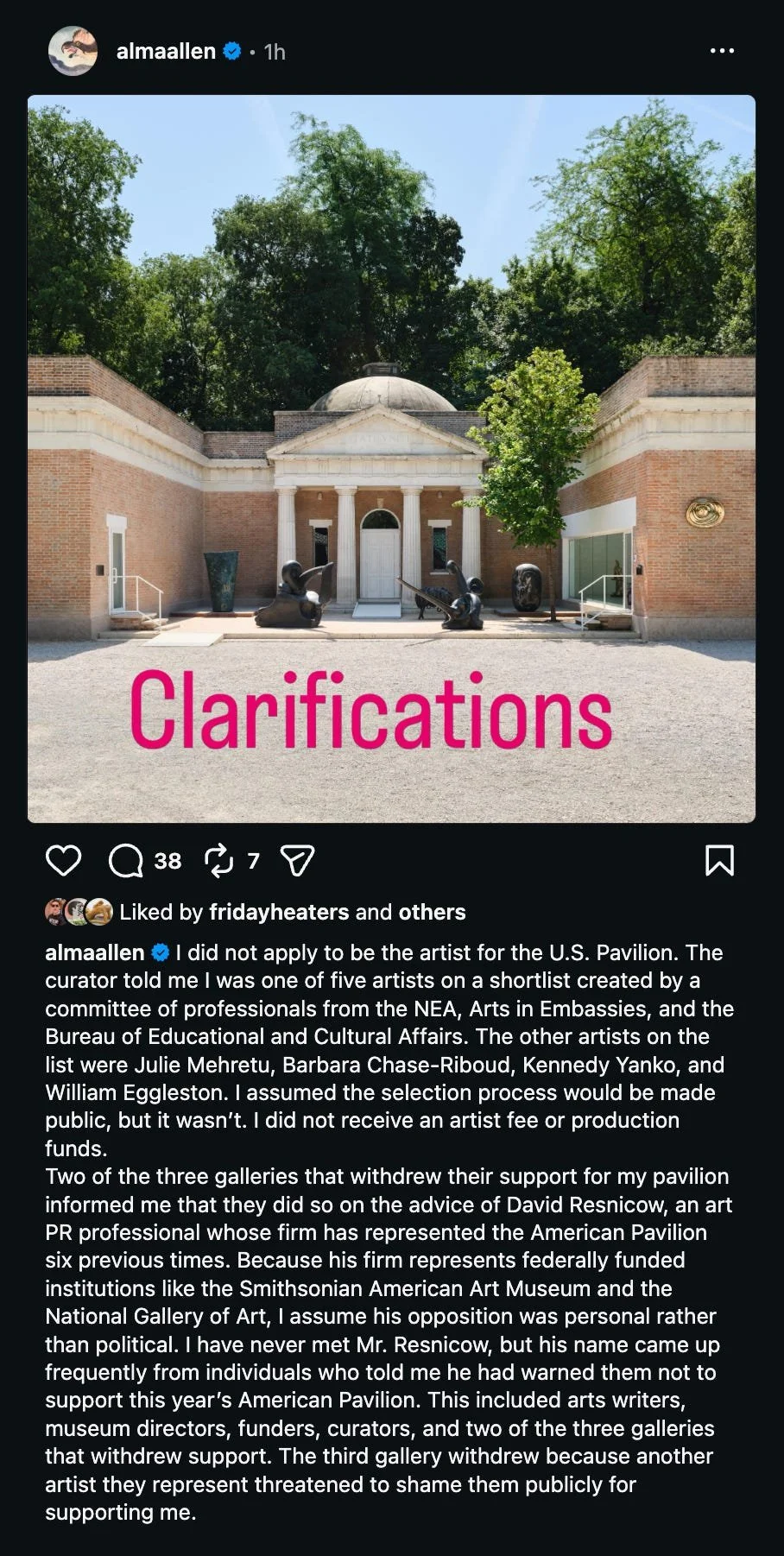
As someone who works with artists, I am sympathetic to Allen’s impulse to shout into the void when it seems like no one is listening. Sometimes it can feel like the only option, but it usually means that the artist does not have the support that they need. Based on my experience, the Venice Biennale isn’t the only place where this happens. It’s just the most visible.
I wanted to take some time to share a little more about how I read this situation, and what I think it says about how we can do better work for artists.
Background
In case you haven’t been following the story, hereis a selectionof a fewgreatpieces that track the timeline and associated controversy around this year’s U.S. Pavilion. If you’d like to hear another take, Jonathan Griffin wrote a thoughtful defense of Allen in Apollo earlier this year. You can also hear Allen speak about his work and what the Venice commission means to him in his conversation with Spencer Bailey on Time Sensitive.
I’m not here to debate the merits of Allen’s work or whether he is the right artist to represent the U.S. at this moment. I also don’t have anything to add to the conversation about the controversy around the way that the commission came together. Others more knowledgeable have already done a great job analyzing this.
What concerns me is that the artist representing the United States found himself, once again, in the position of needing to take matters in his own hands to get his message out. I say “once again” because this happened in 2017 when Mark Bradford represented the U.S. Both times what played out, I want to argue, is the result of a system that neglects to provide artists with the direct PR and communications support that they need. Let me explain.
When artists and institutions have different needs
PR in the art world is, generally, led by exhibiting institutions—galleries, museums, biennials. The institution has the story. It’s their exhibition, so they take the lead on positioning and pitching to writers and editors. Inbound leads get directed to the institution’s PR team. When it comes to the work itself, the artist and / or curator gets looped in to speak about the art.
If the show is at an institution, the artist’s gallery may play a supporting role, but this is usually more logistical than strategic. The gallery PR team doesn’t typically have a direct line to the artist, so everything gets routed through the sales team or the artist’s liaison, which can create its own issues. It gets even more complicated with collecting institutions because they are also potential clients, collecting not just the work of the artist they’re exhibiting but other artists that the gallery represents. The gallery has a vested interest in protecting not only their artist, but also their relationship with the institution.
Normally, this doesn’t create much of an issue because the interests of the artist, the institution, and the gallery normally align, and the story is relatively uncomplicated. Everyone wants maximum visibility on the show. Everyone wants the best journalists to cover it. Coverage drives attention. Attention drives attendance. The reputation of the artist, the institution and the gallery all mutually benefit.
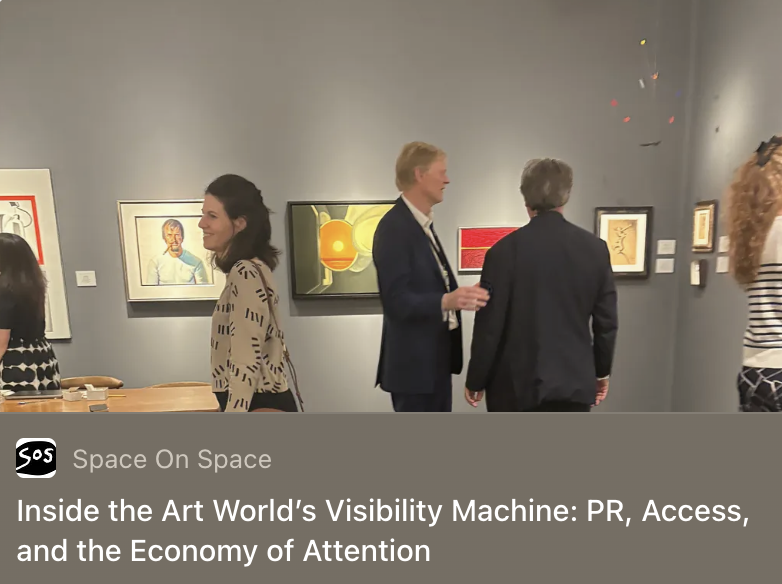
I’m simplifying here, but these are the broad strokes. If you want to read more about the role of PR in the art world, I recommend this piece:
Alma Allen needs something the Pavilion can’t provide
At a certain point, this dynamic starts to break down if the needs and interests of the institution and the artist diverge. In Alma Allen’s case, the Pavilion is dealing with a crisis of credibility due to their unusual selection process and the politically motivated proposal guidelines. The Pavilion wants to promote the work while defending its legitimacy. Allen wants to promote the work while distancing himself from the controversy. Not only are these different objectives, but they also risk coming into direct conflict.
The Pavilion needs to say, There is nothing wrong with how we handled this. Allen wants to say, Not only was it wrong, but I had nothing to do with it. We see exactly this strategy at work in Allen’s Instagram post: “I did not apply to be the artist for the U.S. Pavilion … I assumed the selection process would be made public, but it wasn’t.” Whose fault was that? Not his.
Allen is protecting himself and his reputation from the collateral damage caused by the Pavilion’s mismanagement and putting distance between himself and the process. The Pavilion—and whomever they hire to help them navigate the crisis—cannot credibly amplify that message. So, he takes to Instagram to defend himself on his own terms.
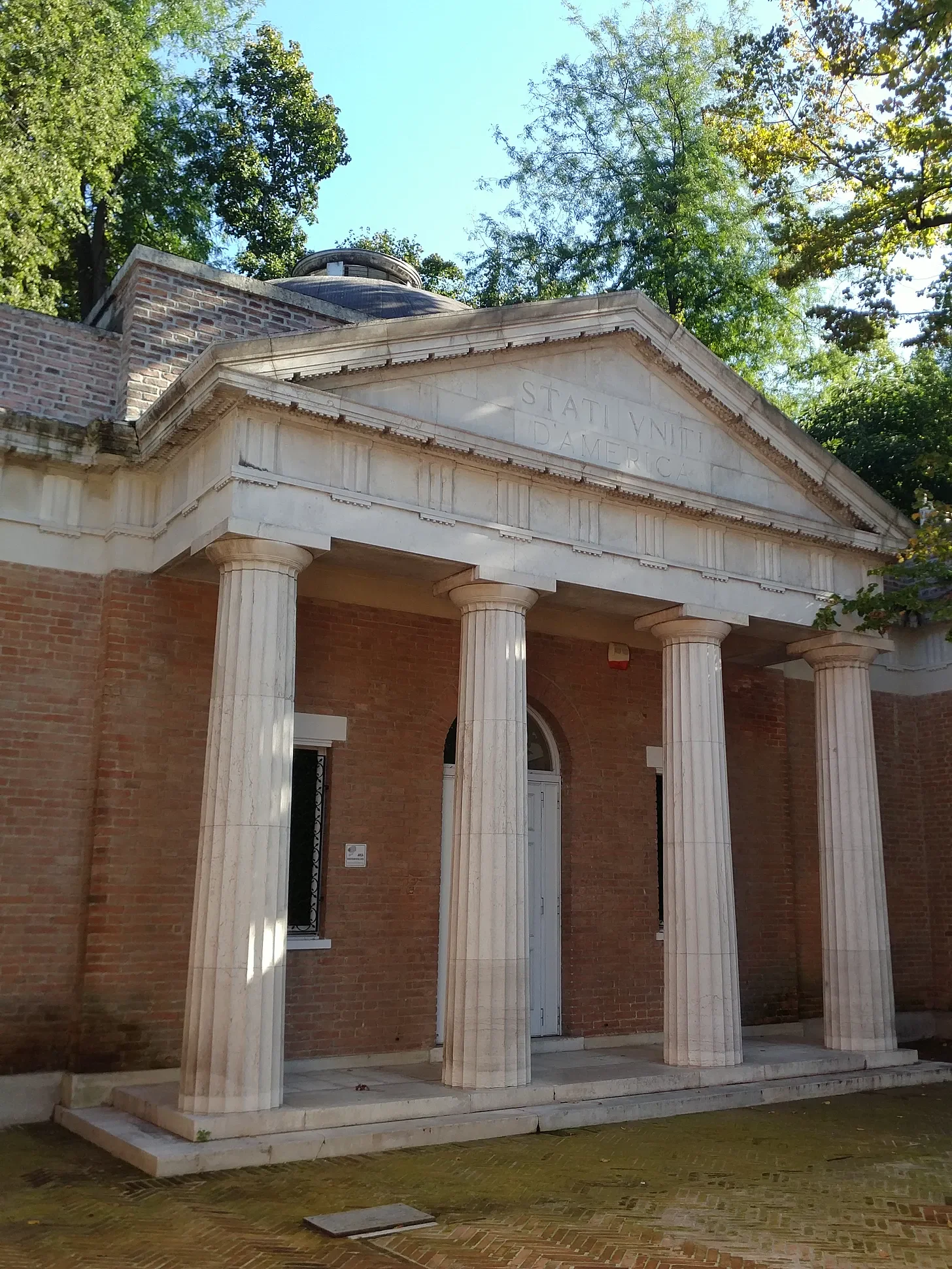
Padiglione Stati Uniti, Giardini della Biennale, Venezia (2020). Photo: Baseluna014. CC BY-SA 4.0.
Where have we seen this before?
In 2017, Mark Bradford ran into his own crisis at Venice when the New York Times published a profile on him in the weeks leading up to the opening of his Pavilion. The images that accompanied the story showed never-before-seen paintings and sculpture staged in a full-size replica of the Pavilion that Bradford had built in a warehouse in South LA. At the time, it was unusual, if not unheard of, for publications to share images of the commissioned work before the opening. The finger-pointing began as soon as Bradford realized he’d been scooped.
In what must have been a chaotic moment, Bradford spoke with Hyperallergic and furiously criticized the Times for what he considered to be an extraordinary breach of protocol. He wasn’t aware at the time—probably because no one had told him—but his own gallery had shared the images. They later acknowledged the error in a follow-up statement. If you aren’t familiar with this story, artnet has the best rundown. It includes a somewhat comical description of requests for comment getting bounced around between different teams.
If you understand how this process works, there is a lot you can read into the narrative. The big takeaway is that at the most significant moment in his career, the artist felt like his only option was to take it into his own hands to speak on the record to defend himself. It is not a decision that someone makes when they are receiving proper public relations counsel.
Bradford’s and Allen’s circumstances are slightly different. In Allen’s case, the controversy was baked in from the beginning. In Bradford’s, someone accidentally shared images that were never intended for publication. I’m less interested in how the crises arrived than I am in how the artists navigated it. The underlying conditions that led them to take things into their own hands are essentially the same.
Representational relationships are non-transferrable, and crises bring this out into the open. If an artist does not have someone looking out only for their best interest, things can go off the rails. It becomes anyone’s guess who’s actually looking out for them, and the only person they know that they can trust is themselves. But it doesn’t have to be this way.
What’s the solution?
I like to look outside the art world for ideas when something doesn’t work. In Hollywood, studios and talent retain their own PR teams. They work together on campaigns around film and television, but the actor’s publicist is the one who manages the process for them. Briefs them, preps them for interviews, and makes sure they never have to speak without having all of the information.
The art world has no equivalent. There’s no expectation that an institution and the artist it’s championing should each have their own team, coordinating where their interests overlap and protecting their respective clients when interests part ways. Instead, there’s usually just one team, hired by and answerable to the institution, asked to direct PR strategy on behalf of both.
Most of the time this goes unnoticed, because most of the time the institution’s interests and the artist’s interests really do point in the same direction. But the arrangement was never built to survive the moment they stop having the same needs. When that moment comes, artists discover that the team speaking on their behalf was never really theirs to begin with.
The full and proper solution to this is for artists, at least during high profile events such as the Biennale, to work with a team of their own, separate and independent from their partner institutions. These teams should cooperate as much as possible because adversarial relationships hurt everyone. PR is not a zero sum game, but the best outcome depends on making sure that everyone has the best team looking out for them, and them alone.
Stay tuned to learn more. In an upcoming post, I will share more about what this would look like in practical terms.