Tune in to the unknown: A note on a way forward for art with the loss of consensus reality
Political art within fragmented realities
Criticism of politically motivated art often centers on shifting cultural values — the “end of woke,” the MAGA-fication of Dimes Square, and the broader rightward tilt — but something deeper is at play.
A recent video on X argued that technology will reach a point soon where not only will AI-videos be indistinguishable from non-AI content, but fact-checking or debunking them will essentially become impossible. We will be left with what can be described as “reality silos,” unverifiable media bubbles that are smaller and more tailored to individual people.
Whether or not Dean Kissick is right that political art is preachy and uninspiring, making art about politics depends on a presumption of consensus reality that is becoming increasingly unrealistic.
The appeal of political art is narrowing just as the audiences within shared reality silos are shrinking. Soon, it may start to feel like screaming into the void.
If that’s your thing, great. Keep at it. But, as the illusion of a common frame of reference fades, the future of art will depend in large part on artists finding new relationships to their own creativity and creative inspiration. Rather than looking out and responding to social ills with critique and futurecasting, some of the most interesting artists working today are starting to look in.
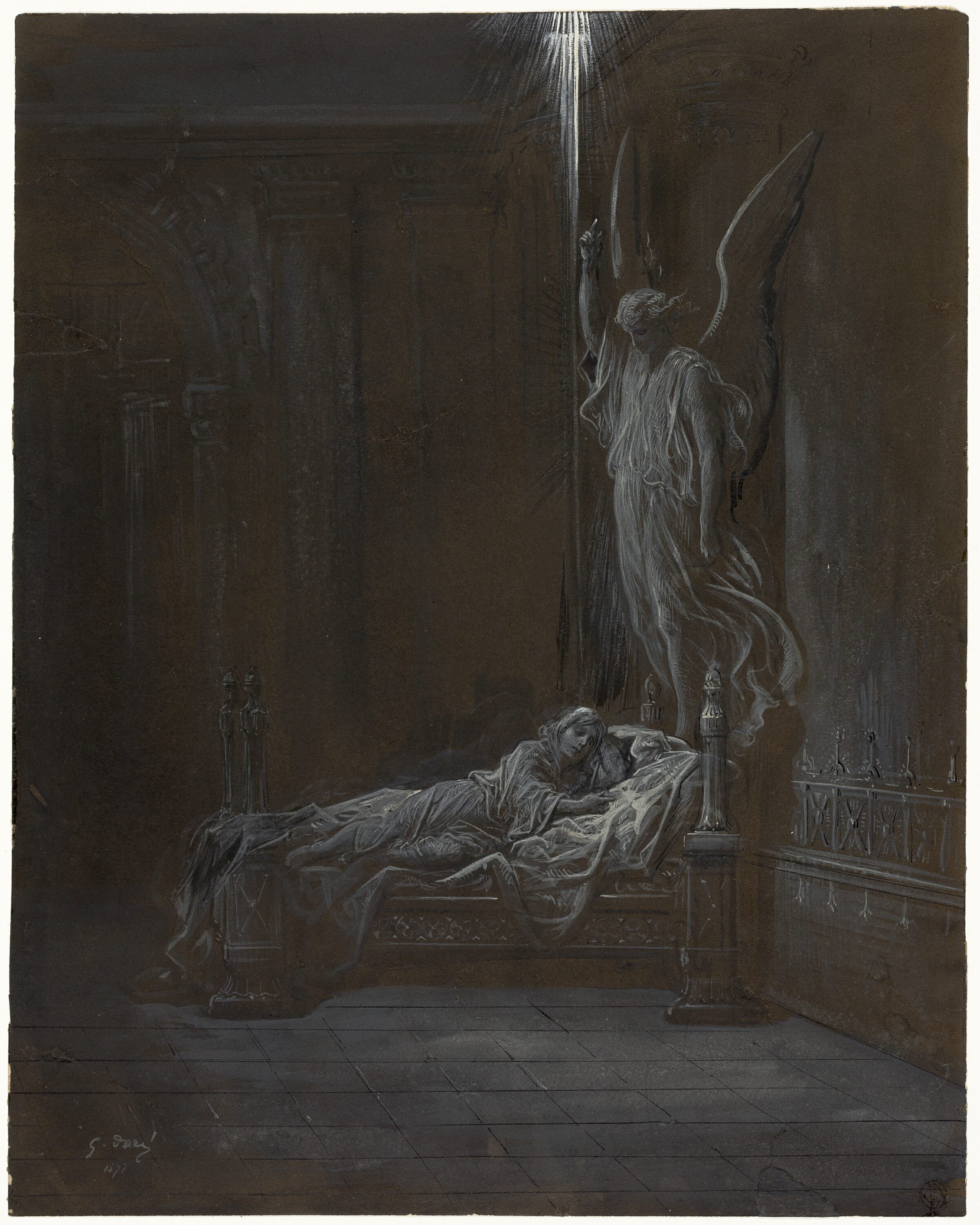
The Calling of Samuel, 1877, Gustave Doré, French, 1832-1883. Public domain. Courtesy: The Art Institute of Chicago
Artists and the search beyond consensus
Consensus reality has always been an open circuit. Mystics, sages, philosophers and artists have a long history of challenging the lodestars of society. They offered alternative visions of where we come from, what it means to be human, and how we should approach life. To do this, they often took great pains to bypass their waking minds.
Beat poets famously used barbiturates, marijuana, and psychedelics to loosen the grip of the conscious mind. Surrealists often drew directly from their dreams or employed automatic drawing to access the subconscious.
Some contemporary artists introduce randomness into their work by using chance or divinatory techniques like the I Ching. Taking it a little more far-out, an artist like Lita Albuquerque meditates, practices Kundalini yoga, and uses automatic writing to channel messages that she attributes to supernatural sources including a 25th-century time-traveling astronaut.
But what does this mean practically? How does an artist do this? And why would artists be interested in shifting their focus in such an out-of-this-world way when the world we live in can seem so terrible for so many?
Creating from the vacuum
This search for unseen sources of inspiration has also found expression in the language of science. Some call it the subconscious, others the imagination, and still others, like Dr. Joe Dispenza, describe it in the language of quantum physics.
In a recent interview with Rick Rubin, Dr. Dispenza did a deep dive into theories of quantum mechanics, frequency, energy, matter, three-dimensionality, and what it means to create something out of nothing. Listen below to a short clip.
Dispenza’s description could double as a definition of the creative process: “[The quantum] is pure consciousness, and in it lies all potentials in a non-manifest, immaterial, non-tangible form. In order for matter to appear, a vibratory sensation must be set into motion in the void or the vacuum. And that’s a thought, right? It’s the realm of thought. It’s the realm of information. It’s the realm of possibility … Everything physical and material comes from it.”
Turning thought into form
Art is the materialization of thought into form. When someone says they don’t understand where their work comes from, this is why. It’s impossible to see, describe, or prove — untestable, beyond space and time.
Our scientific materialist conception of the universe doesn’t leave much room for esoteric ideas about where art comes from, but politics has been a straightforward way to give art heft by pointing to things that we can see and touch. It feels familiar. We know how to place it.
Art that reaches into this “quantum field” demands a leap of imagination — a declaration that things felt but unseen, once transmuted into physical form, hold as much value as anything we can measure. Where political art is siloed, art from the vacuum is boundless. And in fractured realities, boundlessness is what we need most.