Digging into symbols
Form versus content
One of the central binaries in the visual arts is the distinction between form and content. Content is largely understood to refer to what a work is about — a landscape, a still life, a portrait, a manger scene — whereas form refers to the use of lines, shapes, colors, textures, etc. to create the composition of a given work.
Formalism, out of fashion in a lot of ways, is the use of the analysis of form to elaborate on the meaning of a work based on how the work is composed, as opposed to what the work represents.
As formalism has gone out of style, critical analysis of art based in various post-structuralist methods became popular. Looking at a work within the context of its wider socio-political system — means of production and consumption, race, gender, sexuality, and the various relationships between these elements — became the reigning method to understand works of art. Who the artist was became, in a sense, more important than what the art looked like or meant.
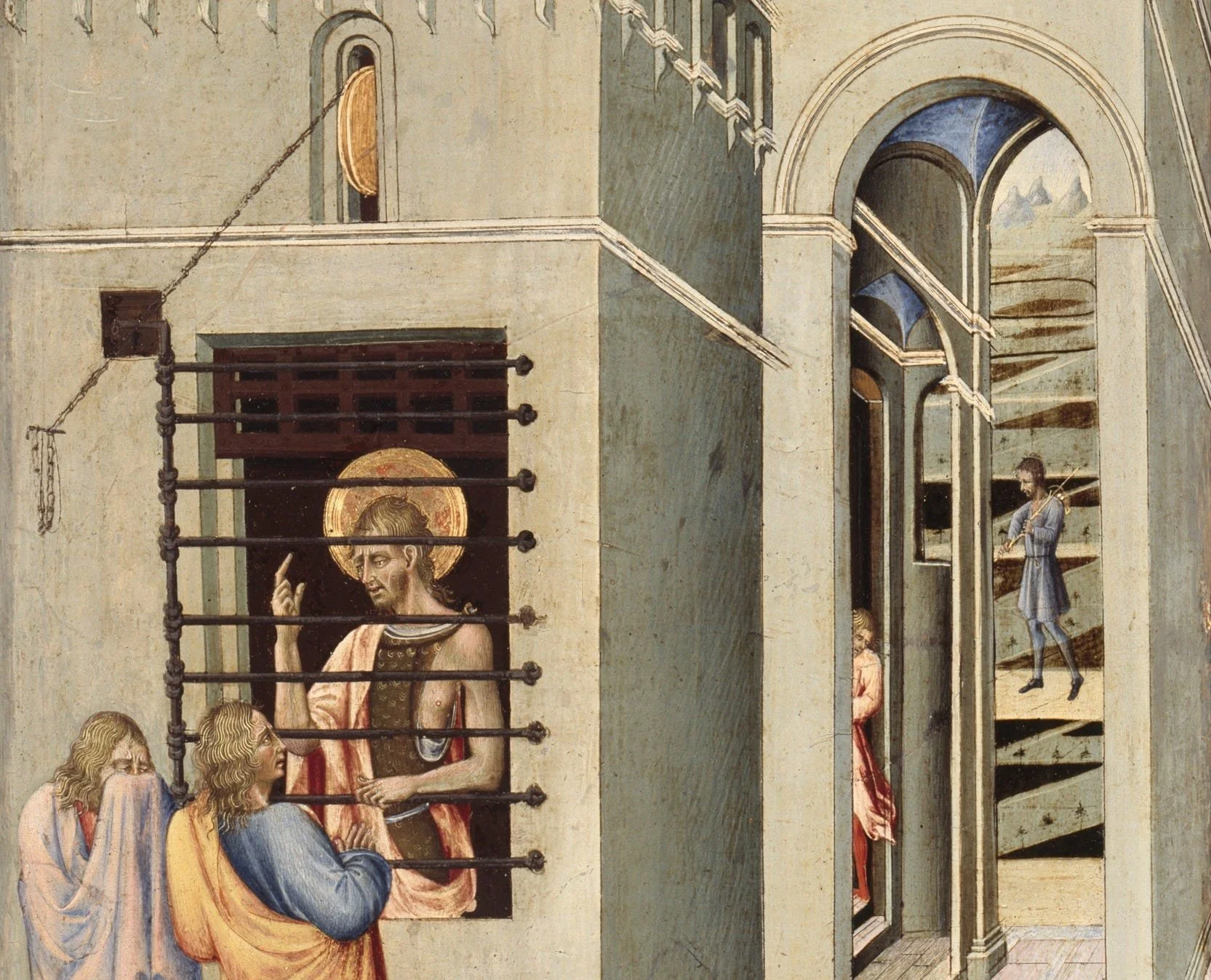
Saint John the Baptist in Prison Visited by Two Disciples (detail), c. 1455, Giovanni di Paolo (Italian, 1398–1482). Public domain. Courtesy: The Art Institute of Chicago
A new decadence
The longer this has been the predominant methodology, the further we have moved from the idea that anything has any fixed meaning outside of relationships of power. This was a response, in part, to the decadence of bourgeois values of aesthetic beauty, oppressive distinctions of high versus low culture, and the idea that art can really say anything specific. The death of the author was the death of fixed meaning. Over time, though, this too has become its own kind of decadent — at times, gratuitous, performative and hollow.
It’s its own kind of privilege to be able to deconstruct things in that it relies on systems that are always, already constructed. Recently, though, as the threads that hold together our social order are tearing, the increasing rootlessness of our social, political, and familial structures has led to a cultural longing for grounding — things to look at and appreciate, objects that elevate the human spirit rather than diminish our self-image.
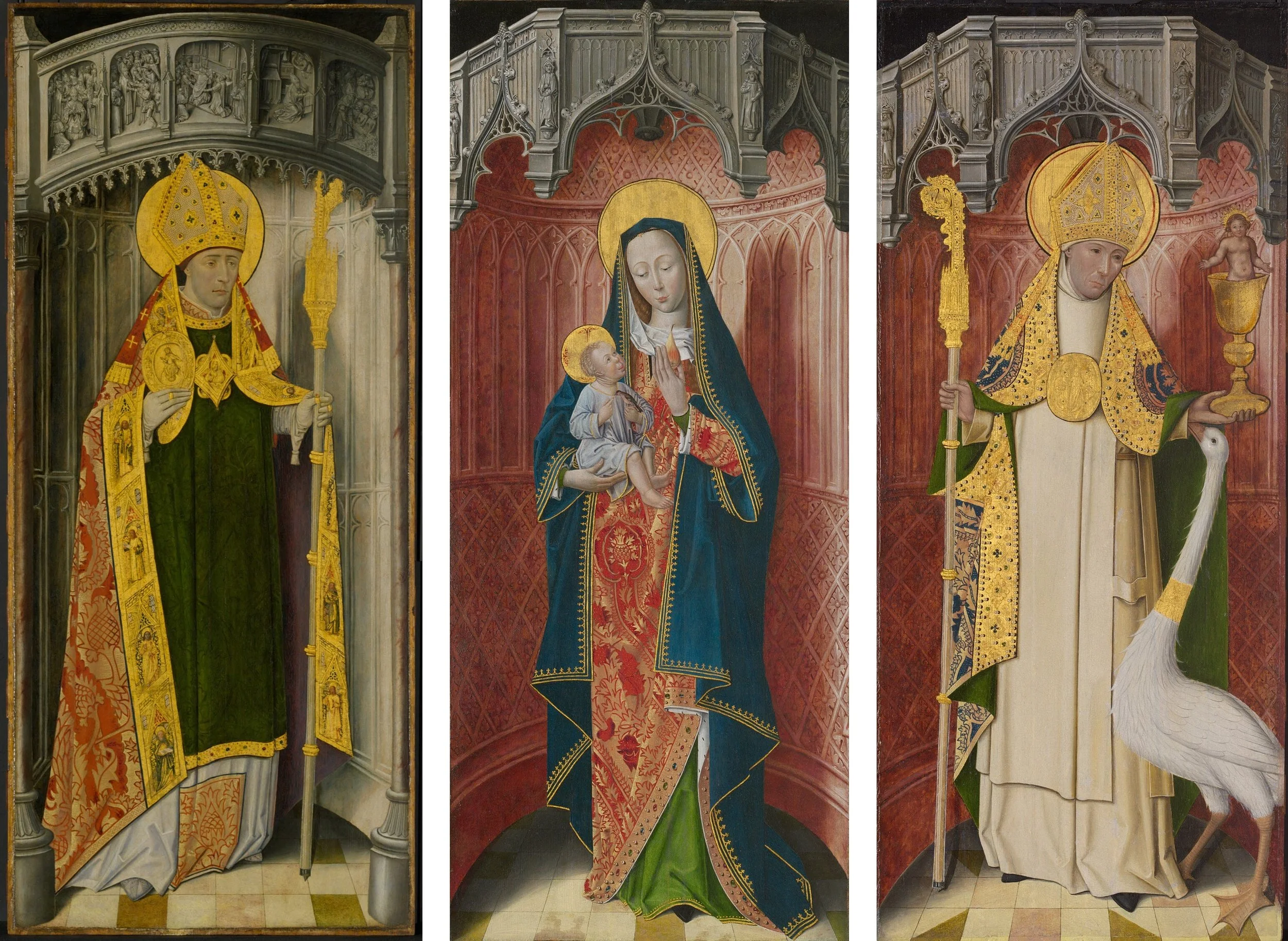
(L) Altarpiece from Thuison-les-Abbeville: Saint Honoré, c. 1495, French; Picardy (C) Panels from the High Altar of the Charterhouse of Saint-Honoré, Thuison-les-Abbeville: Virgin and Child, c. 1495, French; Picardy (R) Altarpiece from Thuison-les-Abbeville: Saint Hugh of Lincoln, c. 1495, French; Picardy. Public domain. Courtesy: The Art Institute of Chicago
Making meaning
What this looks like depends on who you talk to. Some people seek stability in tyrannical politicians. Others find their footing in hatred. The interesting questions people are asking and debating, though, tend to focus on meaning: What is it, and where does it come from? Who or what gives meaning or creates it?
Meaning-making is an uncomfortable experiment because the tendency is to want to impose one’s ecosystem of meaning on others. If someone finds truth, they often see it as their duty to speak it, share it, and impose it on others, infringing on their autonomy. However, there’s nothing about attaining knowledge that requires fervent evangelism. We can seek meaning for ourselves and ourselves alone and let other do the work they need to do.
As Ram Dass says, “We create an environment with our own work on ourselves that we offer to another human being to use to grow in the way they need to grow … because how do I know how they should grow.”
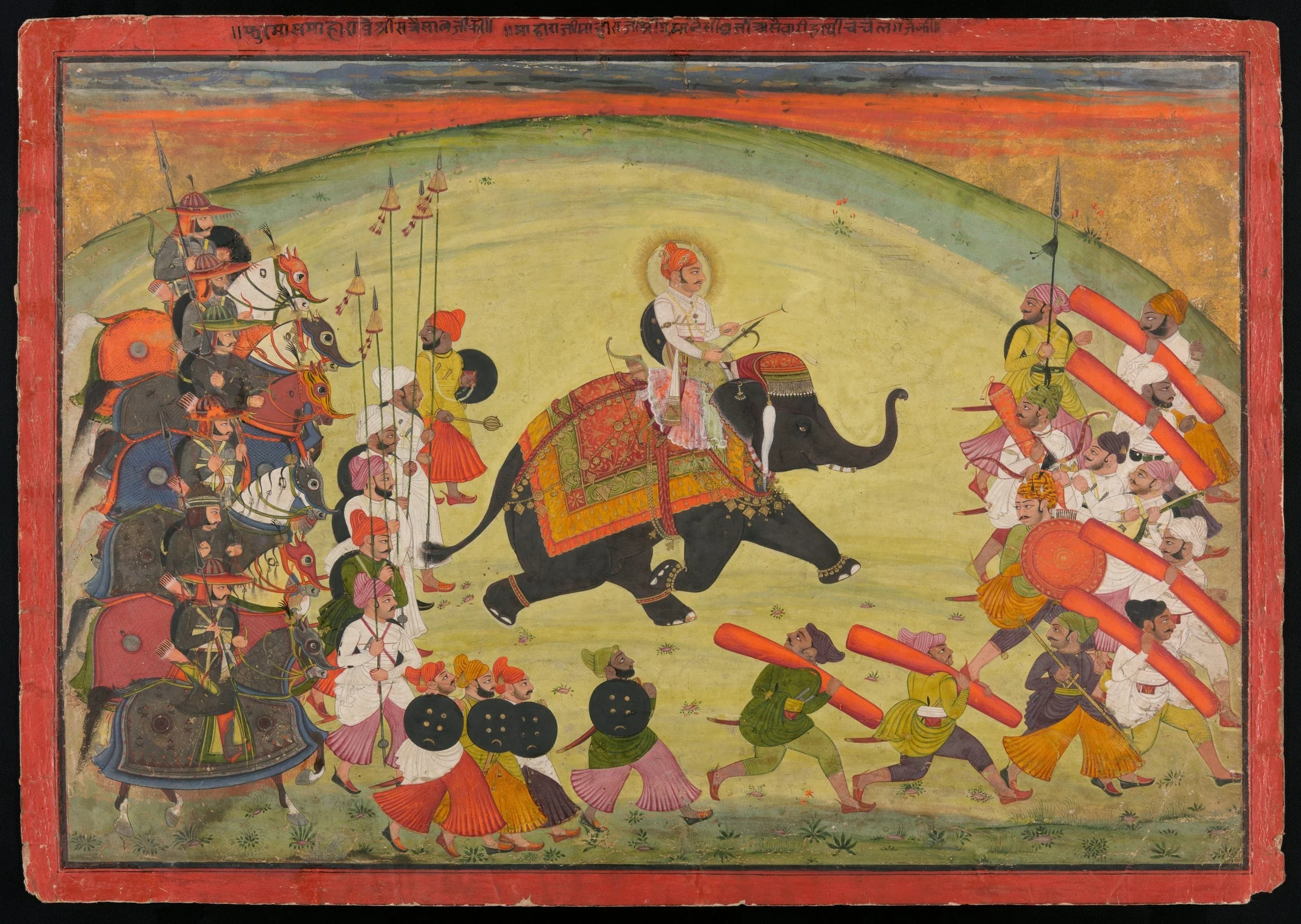
Maharao Guman Singh Riding an Elephant in Procession, dated 1770 (samvat 1827), India, Rajasthan, Kota. Public domain. Courtesy: The Art Institute of Chicago
Humankind and its symbols
An interesting thought experiment is to look at the use of symbols in art and culture and see if there are any consistencies. Some symbols are universal: the phallus to represent masculine, projecting, emitting, electric energy, or the yoni to represent the feminine, receptive, responsive, magnetic energy. Of course, this duality isn’t fixed, and this isn’t meant to project categories onto people who understand their gender in more complex terms, but the binary is lindy.
Another interesting symbol that has been recycled across millennia and vast geographic distances is the halo to represent knowledge, blessings, divinity or enlightenment. In European art, Christ and the Virgin Mary are most frequently represented with halos, signifying their identities as supernatural beings. Later, saints, priests, and others in leadership in the Catholic Church received their halos in official depictions to demonstrate their divine selection as leaders. It was also a convenient way to project power to their congregations.
The Buddha is frequently seen with a halo around his head, as are the leaders of various Buddhist lineages, Hindu divinities, and even political powerbrokers on the Indian subcontinent and in the Middle East.
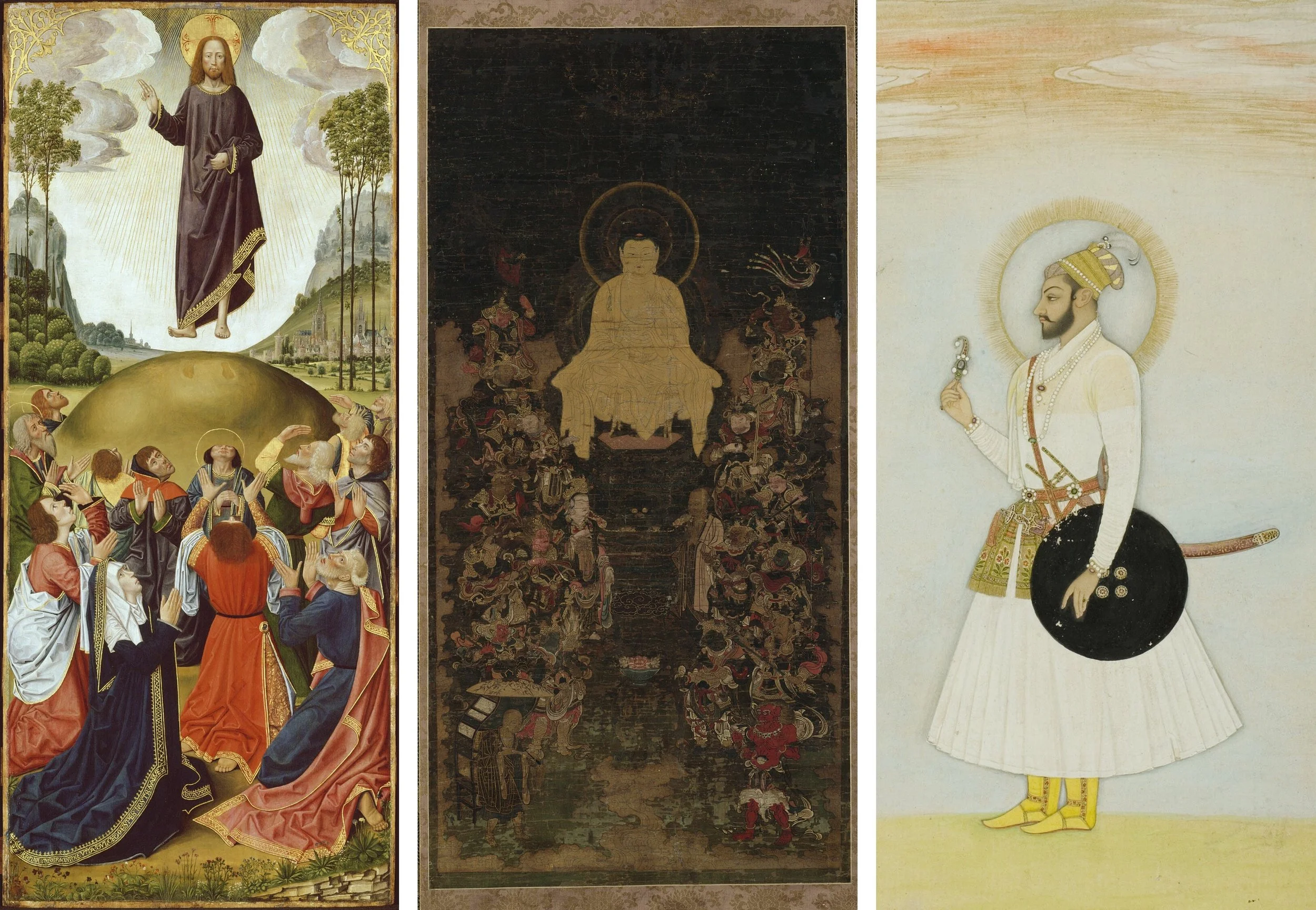
(L) Altarpiece from Thuison-les-Abbeville: The Ascension, c. 1495, French; Picardy (C) The Buddha Preaching the “Perfection of Wisdom” (Prajnaparamita) Sutra, 14th century, Artist unknown, Japanese (R) Portrait of Muhammed Azim, 18th century, India, Rajasthan, Kishangarh. Public domain. Courtesy: The Art Institute of Chicago
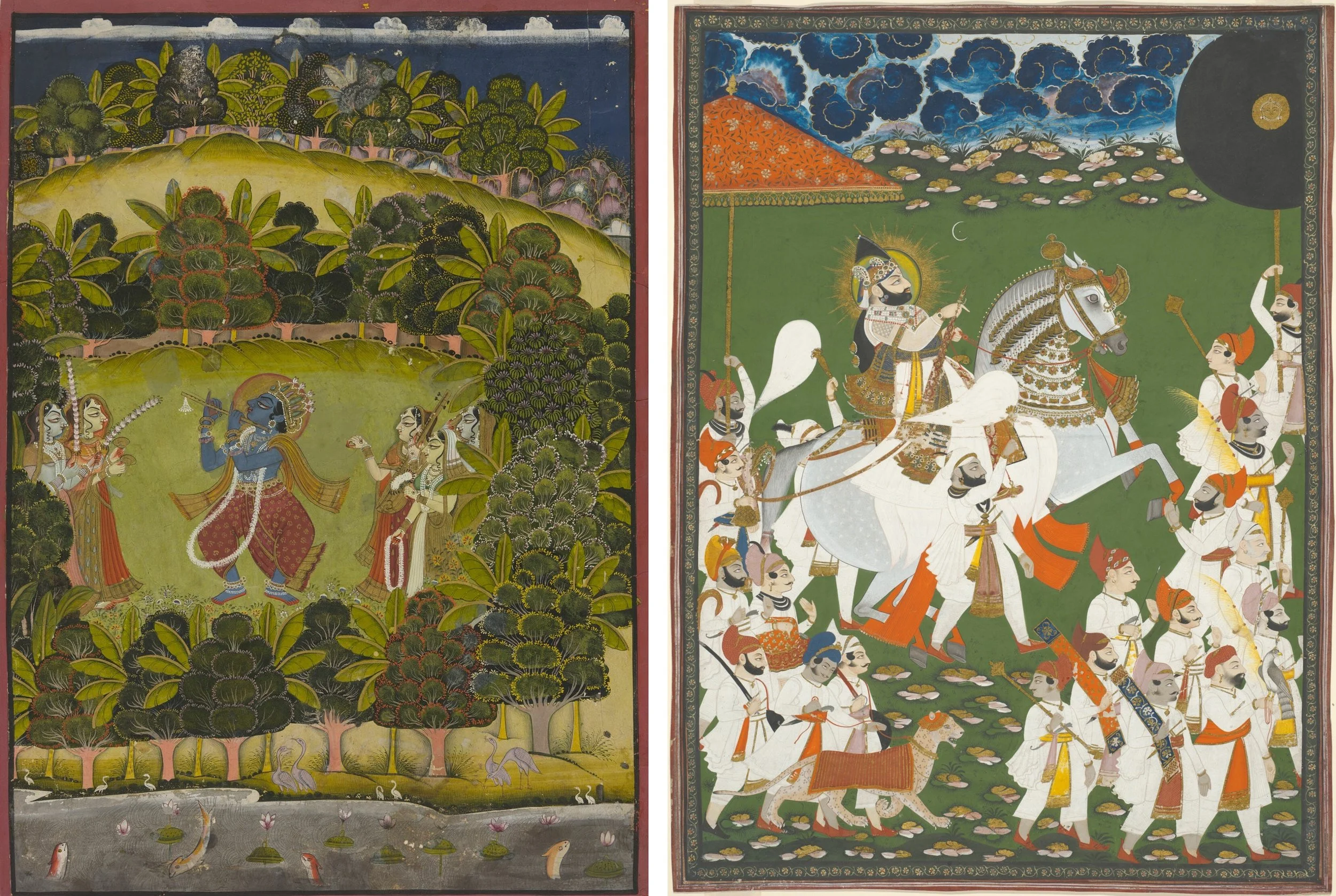
(L) Krishna Fluting for the Gopis, Late 18th or early 19th century, India, Rajasthan, Jodhpur (R) Maharana Bhim Singh in Procession, c. 1820, India, Rajasthan, Mewar, Udaipur, attributed to Ghasi (active c. 1820-36). Public domain. Courtesy: The Art Institute of Chicago
The symbol precedes its elucidation
The occultist, Dion Fortune, wrote in her book The Mystical Qabalah, “It is said that thought grew out of language, not language out of thought. What words are to thought, symbols are to intuition. Curious as it may seem, the symbol precedes the elucidation.”
She refers to the Tree of Life, the central glyph of Qabalistic tradition, and argues that symbols hold meaning prior to their coming to bear in the mind of humans. We can, through meditation on a symbol, discover its meaning. There’s a level of faith required to consider these claims, but perhaps there’s something to be found here, where, by tuning into our subconscious, we can uncover truths too hidden to be known through experience alone.
What, then, of the halo? A halo is a circle of light surrounding the head, our thinking center, which we consider to be the seat of our identity. Often similar in shape and color to the sun, it signifies light beaming around one’s mind. If there is a duality between light and dark, the halo points to the arrival into light from the darkness of the pre-awareness individual.
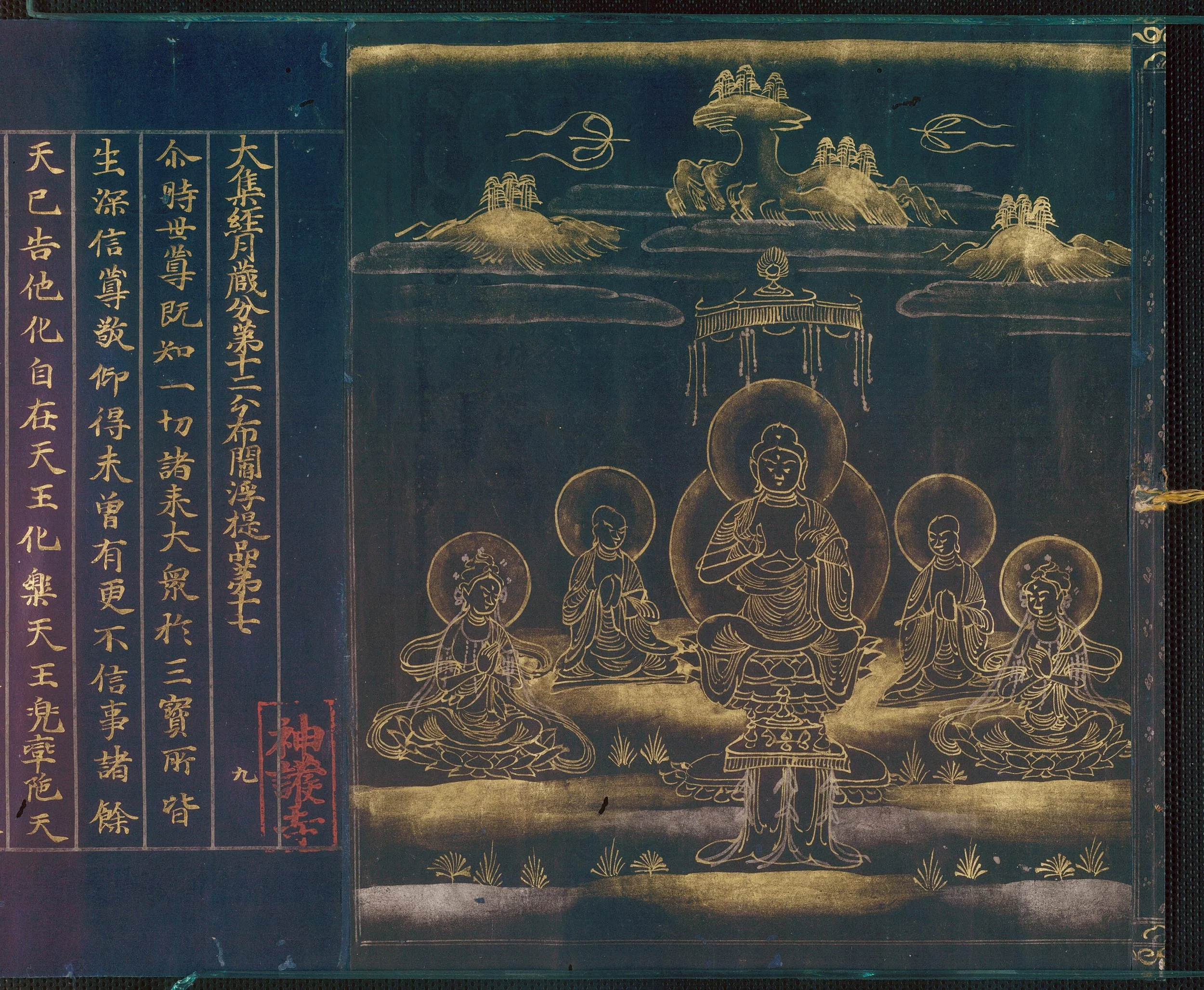
Jingoji Sutra and Wrapper, Late 12th century, Artist unknown, Japanese, active 12th century. Public domain. Courtesy: The Art Institute of Chicago
Tune into the intelligence within
Our Western epistemology has trained us to rely either on a rational or empirical approach to knowledge and understanding. But when our eyes deceive us, when political and social leaders betray us, perhaps the third option is to turn inwards, to tune into our minds to see if there’s something beyond space and time that can teach us something about ourselves.
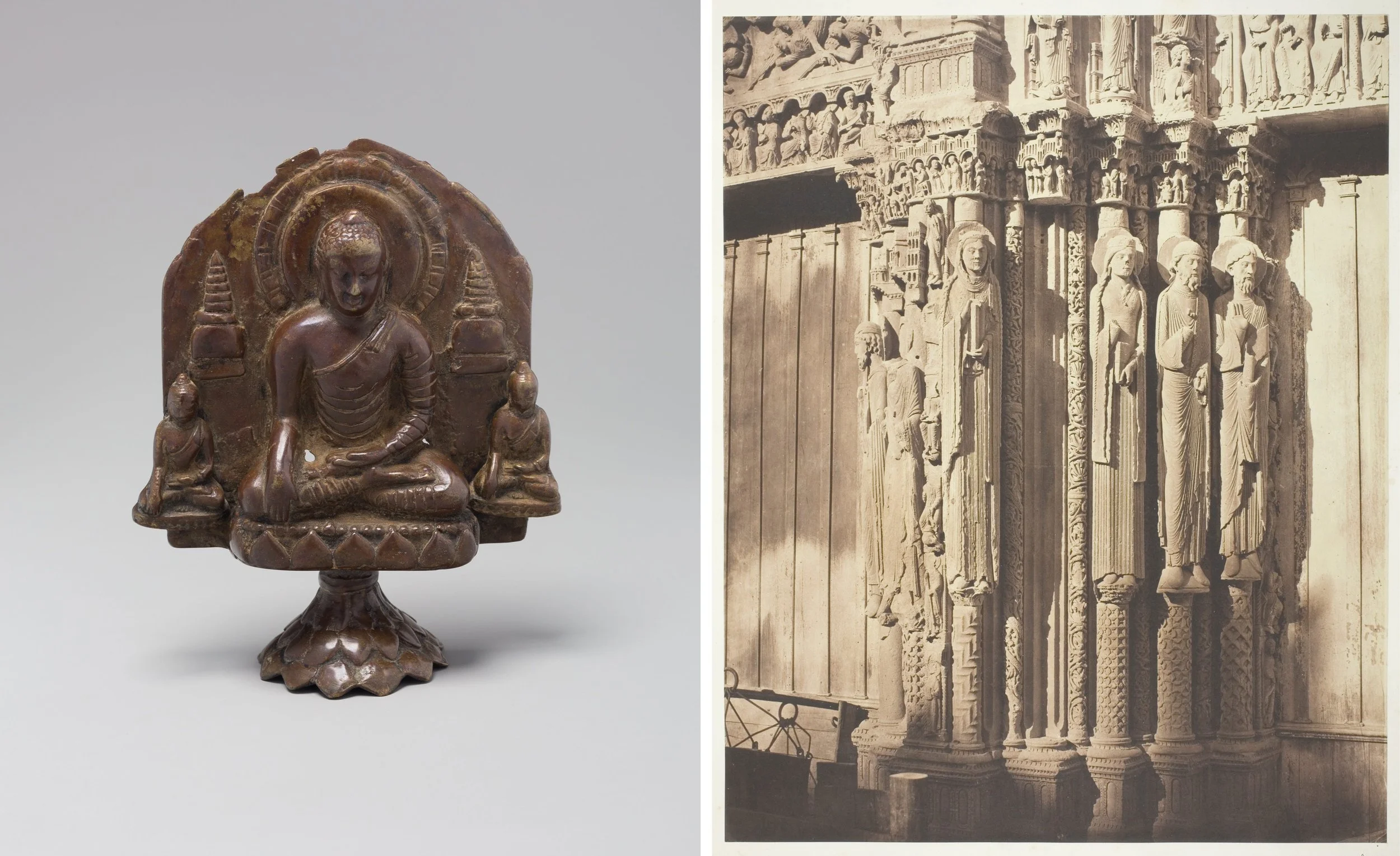
(L) Buddha Calling the Earth to Witness (Bhumisparshamudra), Pala period, 8th/10th century, India, Eastern India (R) Chartres Cathedral, West Facade; Royal Portal, Central Bay, 1857, printed 1857, Bisson Frères (Louis-Auguste Bisson, French, 1814–1876 and Auguste-Rosalie Bisson, French, 1826–1900). Public domain. Courtesy: The Art Institute of Chicago
Great artists already do this when they create work. When asked where their ideas come from, many will say that they don’t know. They don’t understand how a work of art came to be. It just happened. Perhaps they’re tapping into something within themselves, and, if they are, then our response to looking at art makes sense. Looking at beautiful paintings is non-rational. It communicates to a part of our minds that we can’t identify. Ask someone to describe why they like a work of art, and they will often run into the same difficulty articulating their reasons as the artist does when talking about creating it.
It’s cliché to talk about the importance of art “in times like these,” but there is something earnest to be said about that. As science uncovers more about consciousness and the interconnectedness of disparate minds, art makes sense as a method for the transmission of meaning. It’s a way to ground ourselves through wild times. Maybe we’ve just gotten a bit too comfortable, and it’s time to return to where this all began.